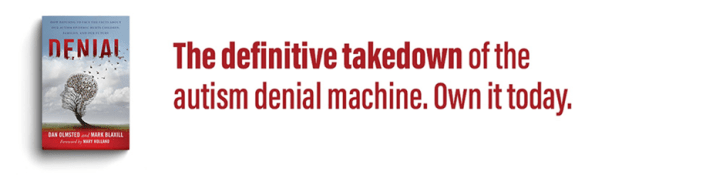
The CDC and legacy media can’t seem to decide whether the prevalence of autism is really increasing or not. The reason we are seeing so much autism these days – 1 in 31 children! – is because of “better diagnosis” or changing diagnostic criteria, they imply. But before he passed away in 2017, Dan Olmsted teamed up with Mark Blaxill to evaluate the truth of these hypotheses. And the title of their resulting book says it all: “Denial: How Refusing to Face Facts About Our Autism Epidemic Hurts Children, Families, and Our Future.” Unfortunately, despite the fact that Secretary Kennedy refuses to allow the federal government to participate in that denial any longer, very little has changed since the book’s release. Children’s Health Defense is taking this opportunity to educate a whole new group of readers with a paperback edition of Olmsted and Blaxill’s groundbreaking work with a brand new foreword from their president, Mary Holland.
Why This Book Is Unlike Any Other
Olmsted and Blaxill meticulously dismantle the argument that autism is an ancient condition — always present in about the same numbers as today — with impeccable logic. The authors collaborated on Age of Autism: Mercury, Medicine and a Man-Made Epidemic. Continuing their search for the truth, they scoured the historical and medical literature going back to the 1800s for case histories of children who behaved the way children with autism do. They found fascinatingly detailed descriptions of rare psychological disorders in children written decades before Leo Kanner and Hans Asperger first described their patients with autism. But nothing in the literature of that time depicted what we now call autism. The authors focus particularly on specific arguments made in the critically acclaimed New York Times bestseller “NeuroTribes” and Pulitzer Prize finalist “In a Different Key.” Step by step, they methodically demolish even their most elegant arguments. “In a Different Key” references a census performed by Samuel Gridley Howe in the 1840s. Howe was tasked with inquiring “into the condition of the Idiots of the Commonwealth, to ascertain their number, and whether any thing can be done on their behalf.” The details of the report Howe wrote for the Massachusetts legislature reveal a great deal about neurological disturbances of that era. But, unlike the authors of “In a Different Key,” Olmsted and Blaxill use them to prove that autism as we know it definitely did not exist in anything like the numbers it does today.
Ready to Order? Available now! No discussion of the meteoric increase in autism prevalence of the last few decades can be valid if it doesn’t include the information contained in “Denial.”
What Readers Are Saying
Astounding. Page turner. I read it twice in a row.
“Everyone should read this. Incredibly strong case. Self-evident…
The authors dissect the opponent’s claims, sources and methodology. The opponents are not only wrong but willfully deceptive in order to serve some kind of hidden agenda. The authors express appropriate rage about this deception for it comes at the expense of millions…
My god what is happening to humanity.”
The truth about the rise in autism
“A thoroughly researched book — and a good read. It would be impossible for anyone to deny the fact that there is an autism epidemic after reading this book. So many people believe the propaganda that ‘there is no increase in autism, it is just a better diagnosis.’ This book proves otherwise. The history of the first cases of autism have been researched and details given in this book. It also has much to say to those that would have people believe that autism is ‘a gift.’ It may be for the few, but for the majority of parents, who love their children dearly, it is heartbreaking and hard work.”
Meticulously researched and extremely well written
“The book reads like a carefully executed courtroom transcript, except it’s real life nonfiction. It is the unfortunate reality that a book like this needed to be written, that we are at a place in society as to be in such complete refusal to acknowledge the soaring rates of disability in children and young adults.
The majority of people whose lives have been impacted by autism know that there is no way this disorder could have gone un- or misdiagnosed for our entire history as humans. Autism is new, it is real, and in most cases it can be devastating.
Bravo to the authors for their constant advocacy in the face of severe adversity.”


